
The question sounds simple. It is not. How much phytoplankton you should dose per day depends on four things that vary significantly from tank to tank: your total system water volume, what is living in the tank and consuming the phyto, how mature your biological filtration is, and how quickly your skimmer and refugium are pulling cells back out before anything can eat them. Give the same dose to a nano reef with one coral and a 200-gallon mixed reef with clams, soft corals, and a dense Tisbe population, and you will get completely different results — one tank will be overfed, the other underfed, both using the same number on the label.
This article gives you a specific starting framework, a set of observable checkpoints to calibrate it, and the reasoning behind each adjustment. By the end you will have a daily or per-session dose that is right for your system, not just a generic recommendation that ignores everything specific about your tank.
The Starting Formula: System Volume, Not Tank Size
The single most common dosing error is calculating based on tank display volume alone. Your sump, refugium, and return plumbing all contain water that dilutes what you add and harbours biology that consumes it. A 100-gallon display with a 40-gallon sump is a 140-gallon system. Dosing for 100 gallons means you are consistently underdosing by nearly 30 percent before you even account for skimmer removal.
The correct starting point is one millilitre of concentrated live phytoplankton per ten gallons of total system volume. For a 140-gallon system that is 14 mL per session. For a 75-gallon display with a 25-gallon sump it is 10 mL. For a nano tank under 20 gallons, the formula drops to 0.5 mL per ten gallons — nano systems have less biological buffering and are more vulnerable to nutrient spikes from overfeeding.
That starting number assumes you are dosing two to three times per week, not daily. True daily dosing — which is the most effective method for tanks with heavy filter feeder loads — uses a lower per-session amount spread across more sessions. Half a millilitre per ten gallons daily produces the same weekly total as one millilitre per ten gallons dosed three times, but maintains a far more consistent cell presence in the water column between doses. For most reef systems, daily or near-daily small doses outperform large infrequent ones for exactly this reason.

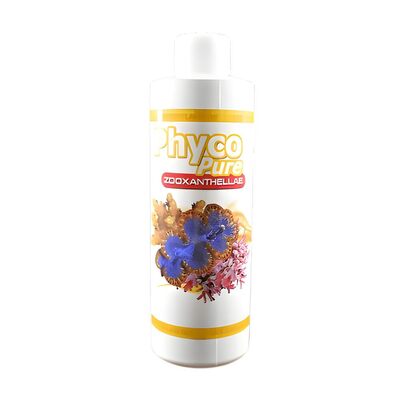
For manual daily dosing, PhycoPure™ Reef Blend is the most practical choice. Measure your calculated dose with a syringe, add it thirty to sixty minutes after lights begin to dim near an area of moderate flow, and the nine-strain diversity means every filter feeder and copepod species in the tank encounters something it can use. Because Reef Blend is concentrated and live, a relatively small daily dose delivers meaningful nutritional coverage across the full range of tank inhabitants without the volume required by lower-density products.
Adjusting for Tank Type and Livestock
The one millilitre per ten gallons formula is a middle-ground starting point. Where you adjust from there depends on what you are keeping. A tank dominated by SPS corals that derive most of their nutrition from zooxanthellae photosynthesis needs far less phytoplankton than a soft coral and clam system where filter feeding accounts for a significant portion of daily nutrition. A tank with a dense Tisbe refugium population consuming phyto rapidly needs more than a fish-only system with minimal biological filter feeder load.
New tanks — under six months old — should start at fifty percent of the calculated dose and build gradually over two to four weeks. The biological consumer community has not yet developed to the level that processes larger doses efficiently, and early overfeeding elevates nitrates and phosphates before the system has the maturity to handle them. Established reefs with refugiums and active pod populations can handle and benefit from the full calculated dose or slightly above it, because the consumption rate is high enough to clear phyto from the water column within hours rather than letting it accumulate.
The Continuous Drip Alternative
For aquarists who want to eliminate the guesswork of per-session dosing entirely, a continuous drip is the most effective and most natural method of phytoplankton delivery. The ocean does not deliver phytoplankton in daily pulses — it maintains a constant background cell concentration that filter feeders and copepods access continuously. Replicating that in a closed system means maintaining a slow, steady drip rather than adding a measured dose and then having nothing until the next session.

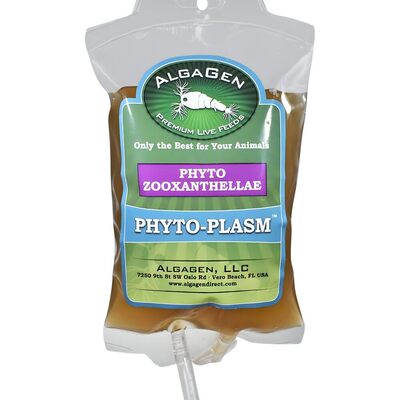
Phyto-Plasm™ Phyto Green in AlgaGen's Easy Feed Packaging is designed specifically for this delivery method. Adjust the drip rate to your system volume and filter feeder load — a slow consistent drip over twelve to eighteen hours delivers the same total cell volume as a manual dose but spread across the entire active period of your tank's biology. Filter feeders get continuous access. Copepods feed throughout the day rather than in a concentrated post-dose window. The skimmer never encounters a spike high enough to pull cells out before anything can eat them. For tanks with clams, heavy soft coral loading, or a large refugium Tisbe culture, the drip method consistently produces better polyp extension, faster copepod reproduction, and more stable parameters than any equivalent volume delivered manually.
| Tank Type | Daily Dose | Per-Session Dose (3x/week) | Best Method |
|---|---|---|---|
| Nano reef under 20 gal | 0.5–1 mL total | 1–2 mL | Manual — skimmer off 1–2 hrs |
| Mixed reef 50–100 gal (system vol) | 5–7 mL | 10–15 mL | Manual or drip — evening dose |
| Reef with clams and heavy soft corals | 8–12 mL per 100 gal system | 15–20 mL per 100 gal system | Continuous drip preferred |
| SPS-dominated reef | 3–5 mL per 100 gal system | 8–10 mL per 100 gal system | Manual — monitor NO3/PO4 weekly |
| Refugium with active Tisbe culture | Add 30–40% of total dose directly to refugium | Same split — refugium first | Drip into sump + manual in display |
| New tank under 6 months | Half the standard dose for your volume | Build to full dose over 3–4 weeks | Manual — increase gradually |
Reading Your Tank: The Real Calibration Tool
Numbers give you a starting point. Your tank gives you the calibration. Three observable checkpoints tell you more accurately than any formula whether your dose is right.
Water clarity is the first. A light green tint in the water immediately after dosing that clears completely within three to six hours indicates the biology is consuming phyto efficiently and your dose is approximately correct. Water that stays green or hazy past twelve hours means you are outpacing consumption — cut back by twenty to thirty percent and retest. Water that clears within thirty minutes of dosing suggests the dose is too small to maintain any meaningful cell concentration between additions.
Pod density is the second. Copepods visible on the glass in increasing numbers at night — white specks crawling across the surface after lights-out — indicate that the phyto dose is fuelling reproduction at the refugium level. A population that stays flat or slowly thins despite regular seeding usually signals that phyto dosing is insufficient to maintain the reproduction rate needed to replace what predation removes.
Coral behaviour is the third. Consistent polyp extension on soft and LPS corals during and after dosing confirms direct uptake. Corals that retract during dosing suggest the volume being added at one time is causing a water chemistry shift — either a brief pH change from the carbon dioxide released by dense phyto, or a salinity shift if the product is being added too quickly. Spreading the dose over a longer addition period resolves this in most cases.
Adjust in increments of twenty percent. Never double or halve overnight. Give each adjustment two weeks before evaluating results, because biological systems respond to changes in phyto dosing over days to weeks, not hours. The right dose is the one your specific tank can use — and that number is something only your tank can tell you.
Frequently Asked Questions
How much phytoplankton should I add to a reef tank per day?
A practical daily dose is 0.5 mL of concentrated live phytoplankton per ten gallons of total system volume — display plus sump. This maintains a steady background cell concentration without the nutrient spikes associated with larger less frequent doses. Adjust up or down based on water clarity after dosing and observable coral and copepod response over two to three weeks.
Should I calculate phytoplankton dose based on tank size or total system volume?
Always use total system volume — display tank plus sump, refugium, and return plumbing. Basing the dose on display size alone underdoses by 20 to 40 percent in most reef systems with sumps, leading to inadequate nutrition for filter feeders and slower copepod reproduction rates than the system is capable of sustaining.
Is it better to dose phytoplankton daily or a few times per week?
Daily small doses are more effective than large infrequent additions for most reef systems. Smaller consistent doses maintain a steadier background cell concentration, reduce nutrient spikes, and provide continuous access for filter feeders and copepods rather than a brief post-dose window followed by hours without available phyto.
How do I know if I am overdosing phytoplankton?
The clearest sign of overdosing is water that stays persistently hazy or green-tinted for more than twelve hours after dosing. Elevated nitrate or phosphate readings that trend upward despite normal feeding otherwise, or a skimmer producing unusually dark and dense skimmate immediately after dosing, also indicate the dose is outpacing biological consumption.
Should I turn off my skimmer when dosing phytoplankton?
Turning the skimmer off for one to two hours after dosing significantly improves phytoplankton uptake by giving filter feeders and copepods time to access cells before they are skimmed out. This is especially important for evening doses when coral polyps are extended and actively feeding. Resume skimming after the biological uptake window has passed.
Related reading:
Phytoplankton Dosing for Saltwater Tanks
Phytoplankton Dosing: Simple Reef Guide
Zooplankton vs Phytoplankton: Reef Food Explained

Recent post