
There is a specific moment in marine fish breeding where almost everything goes wrong, and almost no one talks about it plainly enough. The larvae hatch. They are alive and swimming. They look healthy. Then, over the next forty-eight to seventy-two hours, they begin dying — and they keep dying regardless of what the aquarist does. Water quality is fine. Temperature is stable. The problem is food. Specifically, the absence of appropriately sized live food at exactly the right moment in larval development.
Rotifers solve this problem. They are the standard first food in every serious marine fish hatchery in the world for a reason that comes down to simple biology: newly hatched marine fish larvae have mouth openings measuring as little as 100 to 200 micrometers. Nothing else that an aquarist can practically provide fits through an opening that small. Copepod nauplii are too large. Brine shrimp nauplii are far too large. Rotifers, at 100 to 300 micrometers, are precisely the right size — and they remain suspended in the water column where larvae feed rather than sinking to the bottom out of reach.
What Makes Live Rotifers Different From Frozen
Frozen rotifers exist and are sold widely. They are not the same thing as live rotifers and should not be treated as equivalent for larval rearing. The difference is not primarily about freshness — it is about movement and cell integrity. Live rotifers move. That movement triggers the feeding strike in fish larvae that have not yet learned to hunt stationary prey. A larva that will not touch a dead or frozen rotifer sinking past it will chase and consume a live rotifer swimming through its field of vision. In the first two weeks of larval life, when feeding instincts are being established and survival rates are being determined, that behavioral difference is the gap between a successful spawn and a failed one.
Beyond behavior, the nutritional profile of live rotifers is genuinely superior. Live cells contain intact phospholipids, functioning enzymes, and essential fatty acids — particularly DHA and EPA — in forms that remain bioavailable until the moment of consumption. Freezing ruptures cell membranes and degrades fatty acid profiles. For adult fish the difference is marginal. For larvae developing neural tissue and visual systems in the first week of life, it is not marginal at all.
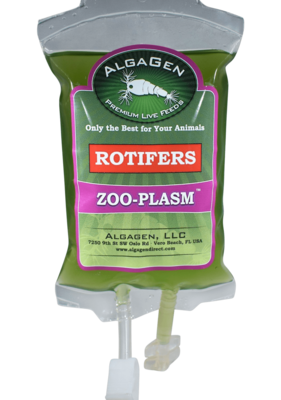
Zoo-Plasm™ Rotifers arrive live, packed fresh on the day of shipment, with no fillers or preservatives. They come in AlgaGen's Easy Feed Packaging — the same drip-delivery format that works for phytoplankton — which allows you to maintain a constant low-level rotifer presence in a larval rearing tank rather than dosing in periodic bursts. For larvae in the first two weeks of life, constant food availability is not optional. Larvae at this stage have very little energy reserve and will starve within hours if the food supply disappears. A gentle drip of live rotifers throughout the photoperiod is as close as a home aquarist can get to the continuous zooplankton density that larvae experience in a natural reef spawning environment.
Gut-Loading: The Step Most Aquarists Skip
A rotifer is only as nutritious as what it has recently eaten. This is the principle behind gut-loading, and it is the single most impactful improvement a marine fish breeder can make to their rotifer feeding protocol. Rotifers that have been starved or fed a poor-quality diet for even a few hours before being dosed into a larval tank are nutritionally hollow — they provide bulk but not the fatty acids and vitamins that larvae actually need for development.

Gut-loading rotifers with PhycoPure™ Reef Blend for two to four hours before adding them to the larval tank gives the rotifers a full digestive load of nutritionally dense live phytoplankton before the larvae consume them. With nine strains including species rich in DHA, EPA, and essential amino acids, Reef Blend produces measurably more nutritious rotifers than any single-strain phyto product. The rotifers themselves are the delivery vehicle — what matters is what they are carrying when they arrive. Dense green rotifers fed on a diverse phyto blend pass those nutrients on intact to the larvae that eat them, supporting the neural development, visual system maturation, and immune function that determine whether larvae survive through metamorphosis or crash before it.
| Larval Stage | Primary Live Food | Rotifer Density Target | Notes |
|---|---|---|---|
| Day 1–3 (first feeding) | Live rotifers only | 5–10 rotifers per mL | Gut-load 2–4 hrs before dosing; drip continuously |
| Day 4–10 | Live rotifers — primary | 10–15 rotifers per mL | Increase density as larvae grow; monitor water quality |
| Day 11–21 | Rotifers + copepod nauplii | 5–10 rotifers per mL | Introduce copepod nauplii as mouths enlarge |
| Day 22+ (metamorphosis) | Copepod nauplii primary; rotifers secondary | 2–5 rotifers per mL | Transition to larger prey as fry develop |
| Established fry (post-settlement) | Copepods + small frozen foods | Supplemental only | Rotifers remain useful for SPS coral feeding at this stage |
Rotifers Beyond Breeding: Reef Tank Applications
Live rotifers are essential for breeding, but their usefulness does not stop there. In an established reef tank, rotifers serve a genuinely different purpose that has nothing to do with larvae. At 100 to 300 micrometers, they are the right size for the feeding polyps of small-polyp stony corals — SPS species that find copepod nauplii difficult to capture but readily intercept suspended rotifers drifting through their tissue. Reef tanks dosed consistently with live rotifers two to three times per week alongside phytoplankton show improved coral polyp extension, faster growth rates, and more consistent coloration compared to tanks relying on phytoplankton alone.
The practical protocol for reef dosing is the same as for larval feeding in principle — consistency and delivery matter more than volume. Dose rotifers after lights begin to dim, when coral polyps are extending for their nightly feeding cycle. Reduce flow briefly during dosing to keep rotifers suspended near coral surfaces long enough to be captured. A turkey baster allows targeted delivery directly to coral colonies rather than broadcasting rotifers into open water where they are rapidly exported. Small, frequent doses over time produce far better results than large infrequent additions.
Whether the goal is raising a clownfish spawn, supporting the feeding of a demanding SPS coral, or simply adding the right particle size to a reef food chain that is missing it, live rotifers fill a role that nothing else matches at their size. The key is sourcing them live, enriching them before use, and delivering them with enough consistency that the biology depending on them always has access to what it needs.
Frequently Asked Questions
When do I start feeding rotifers to marine fish larvae?
Begin offering live rotifers at first feeding — typically 24 to 48 hours after hatching when the yolk sac is absorbed and larvae begin actively searching for food. Maintain a density of 5 to 10 rotifers per millilitre in the larval tank continuously during the first two weeks. Never let the rotifer supply run out during this critical window.
What is gut-loading and why does it matter for rotifers?
Gut-loading means feeding rotifers a nutrient-rich phytoplankton diet for two to four hours before dosing them to larvae. Rotifers transfer the nutritional content of their gut to the larvae that eat them, so a well-fed rotifer delivers significantly more DHA, EPA, and essential amino acids than a starved one. Using a multi-strain phyto product like PhycoPure Reef Blend maximises this nutritional transfer.
Can I use rotifers in a reef tank without a breeding setup?
Yes. Live rotifers are highly effective for feeding SPS coral polyps and other small filter feeders in an established reef tank. Their size — 100 to 300 micrometers — matches the feeding apparatus of many small-polyp corals that cannot efficiently capture copepod nauplii. Dose two to three times per week after lights begin to dim for best coral uptake.
How long do live rotifers last after purchase?
Live rotifers are typically viable for several days to a week after purchase when stored correctly — cool temperatures, gentle aeration, and a small amount of phytoplankton to keep them fed. For breeding programmes requiring daily availability, culturing your own rotifer population from a purchased starter culture is more practical than buying bottles continuously.
What size are rotifers and which fish larvae can eat them?
Rotifers typically range from 100 to 300 micrometers in size. This makes them appropriate as a first food for the larvae of most marine fish species — including clownfish, dottybacks, gobies, and many angelfish and wrasse species — whose initial mouth openings are too small to accept copepod nauplii or brine shrimp nauplii.
Related reading:
Live Rotifers for Sale: Ultimate Aquarium Nutrition Guide
Rotifers in Reef Tank: Pros and Setup
Rotifers for Sale: Culture vs Buy

Recent post