
Most aquarists notice copepods before they understand them. Little white specks darting across the glass at night. Tiny shapes skimming the sandbed or disappearing into rock. The first instinct is often to wonder if something is wrong. It is not. Those specks are one of the best signs your tank can give you — a signal that the biological foundation is working the way it is supposed to.
Copepods are microscopic crustaceans that exist in virtually every body of water on the planet. They are not parasites, not pests, and not a problem to be solved. They are the base of the marine food web — the organisms that sit between phytoplankton and everything else, converting microscopic plant matter into animal protein that fish, corals, and invertebrates can actually use. A tank with a thriving copepod population is a tank with real, functional biology. A tank without them is just saltwater and equipment.
Understanding what copepods actually do inside your aquarium — and what their presence or absence tells you — changes how you think about tank management entirely.

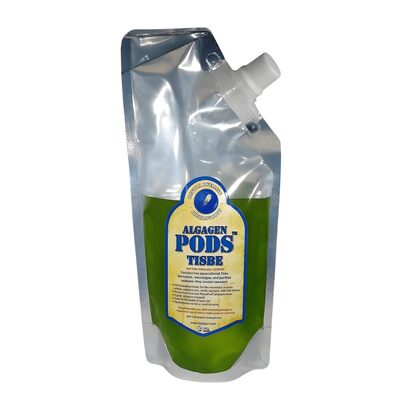
There are two behavioral types that matter most in a home aquarium. Harpacticoid copepods, like Tisbe biminensis, are bottom-dwellers. They crawl through substrate, across rock faces, through algae mats, and into every crevice the mechanical filter cannot reach. They consume detritus, bacterial films, diatoms, and uneaten food particles. In practical terms, they are doing the kind of granular cleanup that no skimmer or powerhead can replicate. AlgaGenPods™ Tisbe is the go-to choice for establishing this benthic cleanup layer — and because Tisbe reproduces rapidly and prefers surfaces over open water, it builds population density even in tanks with active pod-eating fish.
Cyclopoid copepods, like Apocyclops panamensis, behave differently. They move between the substrate and the water column — a behavioral range that makes them far more visible and accessible to fish hunting in open water. They are bigger than Tisbe nauplii, which makes them an ideal target for anthias, blennies, wrasses, and other planktivorous species that need live food to maintain their condition in captivity. AlgaGenPods™ Apocyclops fills this role precisely — a semi-pelagic pod that provides genuine live feeding opportunity in the water column throughout the day.

Running both species together gives you full-spectrum biological coverage. Tisbe handles the substrate and rock surfaces. Apocyclops handles the water column. The two populations do not compete with each other — they occupy different ecological niches and together replicate the kind of layered zooplankton community that real reef systems rely on. Fish that were sluggish or color-faded often show visible improvement within weeks of a proper copepod seeding, simply because they are finally getting the live protein their biology requires.
| What You See | What It Means | What To Do |
|---|---|---|
| Pods on glass at night | Healthy benthic population establishing | Nothing — this is a good sign. Maintain phyto dosing. |
| No pods visible after seeding | Heavy predation or poor hiding habitat | Seed refugium first, add at night, reduce wrasse or six-line pressure |
| Fish hunting actively near rock | Pods present and being consumed naturally | Re-seed monthly to replenish; consider refugium export |
| Cloudy or dusty sandbed | Insufficient benthic microorganisms | Add Tisbe pods directly to sandbed area |
| Mandarin or dragonet eating well | Pod population is dense and self-sustaining | Keep refugium seeded; dose phyto 2–3x per week |
| Fish pale, lethargic, not feeding | Live food absent or inadequate | Seed immediately with Apocyclops; add Tisbe to refugium |
What copepods signal about your tank goes beyond just food availability. A tank that sustains a copepod population is a tank with stable parameters, adequate biological filtration, and enough organic matter — but not too much — to support a living microfauna layer. When a copepod population crashes or fails to establish, it is almost always traceable to something upstream: too much predation pressure, insufficient food supply, a recent chemical treatment, or a parameter spike that wiped out the culture before it could root. The pods are a signal. Pay attention to what they tell you.
For freshwater tanks, the biology works the same way in principle, just with different species. Bio-actiV Freshwater Plankton™ delivers live freshwater-adapted copepods and ostracods that perform the same detritus processing and live food functions in a freshwater system that Tisbe and Apocyclops do in a marine one. The underlying logic — seed intentionally, feed consistently, protect the population — applies equally to both environments.
The most important shift in thinking is this: copepods are not an accessory you add to a mature tank as a treat for your mandarin. They are infrastructure. They should go in early, be maintained consistently, and be thought of as a core part of the biological system rather than an optional supplement. A tank built with that understanding from the start is a fundamentally different system than one built without it — more stable, more self-correcting, and far more rewarding to keep over time.
Frequently Asked Questions
Are copepods on my aquarium glass a problem?
No — copepods on the glass are a positive sign. They indicate a healthy, reproducing population is establishing in your tank. They are most visible at night when they emerge from rock and substrate to graze on biofilm.
What is the difference between Tisbe and Apocyclops copepods?
Tisbe biminensis is a benthic harpacticoid copepod that lives on surfaces — substrate, rock, and algae mats. Apocyclops panamensis is a cyclopoid that moves between the substrate and water column, making it more accessible to fish hunting in open water. Running both together provides full-spectrum tank coverage.
How do I know if my copepod population is healthy?
Healthy signs include pods visible on the glass at night, fish actively hunting near rockwork, a cleaner sandbed between water changes, and mandarin or dragonet fish feeding naturally. A crash or absence typically signals predation pressure, a missing food source, or a recent parameter or chemical disruption.
When should I add copepods to a new aquarium?
Add copepods after the tank has completed its nitrogen cycle and parameters have stabilized. Introducing them too early during an ammonia spike will wipe out the culture before it can establish. For reef tanks, seeding the refugium first — before adding pod-eating fish to the display — gives the population the best start.
Can copepods survive in a freshwater aquarium?
Yes, with the right species. Marine copepods like Tisbe and Apocyclops require saltwater. For freshwater tanks, Bio-actiV Freshwater Plankton from AlgaGen Direct contains live freshwater-adapted copepods and ostracods that thrive in freshwater conditions and provide the same cleanup and live food benefits.
Related reading:
Aquarium Pods: Tiny Heroes of Your Tank
Copepods for Saltwater Aquarium
Six Essential Saltwater Copepods for Marine Aquariums

Recent post